Add TopTechs as a preferred source
The best inverter battery for most Indian homes is the Luminous Inverlast ILTT 18060 at around ₹14,099. It is a 150Ah tall tubular battery with a 60-month warranty: 36 months of free replacement, then 24 months pro-rata. Buyers on Amazon.in rate it 4.3.
By our estimate, a 150Ah battery runs 3 fans, 6 LED bulbs and the WiFi router (about 300W) for roughly 4 hours, and a 200Ah battery adds about 1 hour 20 minutes. We compared six batteries from ₹10,250 to ₹18,499, including a lithium one that never needs water.
For about ₹1,600 less, the Okaya PROPower gives 160Ah and 36 months of free replacement.
Quick answer
- Best overallLuminous Inverlast ILTT 18060, 150Ah tall tubular, 36 months free + 24 pro-rata, around ₹14,099
- Best valueOkaya PROPower OPSJT19060, 160Ah super jumbo tubular, 36 months free + 24 pro-rata, around ₹12,490
- Best budgetOkaya PowerON OPSJT17048, 140Ah super jumbo tubular, 24 months free + 24 pro-rata, around ₹10,250
- Best for long power cutsTata Green Switch-On INTT240072, 200Ah tall tubular, 36 months free + 36 pro-rata, around ₹17,348
- Best Exide batteryExide InvaMaster IMTT1500, 150Ah tall tubular, 36 months free + 24 pro-rata, around ₹14,398
- Best lithium batteryMicrotek MLB1280060, 100Ah lithium (1280Wh) for Microtek Next-Gen inverters, 5-year warranty (split not published), around ₹18,499
Prices, ratings and review counts checked on 13 October 2026 on Amazon.in. Prices change often, so tap any name for the live price.
Inverter battery prices: quick comparison
Sorted by price. More Ah (amp-hours) means more stored charge and longer backup.
| Battery | Price | Capacity | Type | Warranty in months (free + pro-rata) | Backup at 500W* | Rating (reviews) |
|---|---|---|---|---|---|---|
| ~₹10,250 | 140Ah, 12V | Super jumbo tubular | 24 + 24 | 2 hr 17 min | 4.3 (482) | |
| ~₹12,490 | 160Ah, 12V | Super jumbo tubular | 36 + 24 | 2 hr 37 min | 4.2 (93) | |
| ~₹14,099 | 150Ah, 12V | Tall tubular | 36 + 24 | 2 hr 27 min | 4.3 (216) | |
| ~₹14,398 | 150Ah, 12V | Tall tubular | 36 + 24 | 2 hr 27 min | 4.2 (174) | |
| ~₹17,348 | 200Ah, 12V | Tall tubular | 36 + 36 | 3 hr 16 min | 4.3 (160) | |
| ~₹18,499 | 100Ah at 12.8V (1280Wh) | Lithium (LiFePO4), for Microtek Next-Gen inverters | 60 total, split not published | 1 hr 44 min | 4.3 (202) |
*Our estimate, using the formula below. Real backup is often a little lower.
How long will a 100Ah, 150Ah or 200Ah inverter battery last?
At 300W, a 100Ah battery lasts about 2 hours 45 minutes, a 150Ah about 4 hours and a 200Ah about 5 hours 25 minutes. At 800W, the same three last roughly 1, 1.5 and 2 hours. Double the load and the backup falls by half or more.
| Battery | 300W load | 500W load | 800W load |
|---|---|---|---|
| 100Ah lead-acid, 12V | 2 hr 43 min | 1 hr 38 min | 1 hr 1 min |
| 150Ah lead-acid, 12V | 4 hr 5 min | 2 hr 27 min | 1 hr 32 min |
| 200Ah lead-acid, 12V | 5 hr 26 min | 3 hr 16 min | 2 hr 2 min |
| 100Ah lithium, 12.8V (1280Wh) | 2 hr 54 min | 1 hr 44 min | 1 hr 5 min |
We used one formula for every backup time: backup in hours = Ah × 12 × 0.8 × 0.85 ÷ watts. The 12 is the battery voltage. The 0.8 means drawing only 80% of the stored charge, as in Livguard's backup guide, so the battery is not deeply discharged after every use.
The 0.85 allows for power lost as heat inside the inverter. Microtek's spec sheets list its inverters at over 85% efficiency. The two factors give 0.68, close to the 0.7 our inverter guide uses.
The lithium row uses its 1280Wh instead of Ah × 12. The 0.8 still applies, because Microtek also quotes 80% depth of discharge.
Typical appliance sets for each load:
- About 300W. 3 ceiling fans, 6 LED bulbs, the WiFi router and a phone charger.
- About 500W. 4 fans, 8 LED bulbs, a 43-inch LED TV and the WiFi router.
- About 800W. The 500W set plus a fridge and a room cooler, which draw 100 to 200W each.
Okaya publishes backup times measured by a lab accredited by NABL, the Indian body that accredits test labs. Here they are next to our formula:
| Load | Okaya 160Ah, certified | Our formula, 160Ah | Okaya 140Ah, certified | Our formula, 140Ah |
|---|---|---|---|---|
| 200W | 8 hr 0 min | 6 hr 32 min | 6 hr 35 min | 5 hr 43 min |
| 300W | 4 hr 40 min | 4 hr 21 min | 3 hr 50 min | 3 hr 48 min |
| 400W | 3 hr 5 min | 3 hr 16 min | 2 hr 30 min | 2 hr 51 min |
So the formula matches Okaya closely at 300W, reads low at 200W and reads a little high at 400W. Treat the 500W and 800W columns as best cases, since Livguard notes that heavy loads cut backup further. Okaya also says charging through an inverter does not fill a battery to 100%.
An 800W load also needs a bigger inverter. Since a 900VA model handles only about 750W, choose 1100VA or more. Our best inverter for home guide explains sizing.
Which inverter battery gives the most warranty for your money?
The Okaya PROPower. Its price comes to about ₹347 for each month of free replacement. The Luminous Inverlast and Exide InvaMaster follow at about ₹392 and ₹400. Luminous's popular Red Charge batteries cost about twice as much per month, because they give only 18 months of free replacement.
In the free-replacement period, a faulty battery is replaced free. In the pro-rata period, you pay part of the price of a new one, based on how long you used the old battery. We divided each price by those free months.
| Battery | Price | Free replacement (months) | Pro-rata (months) | Cost per free month | Cost per month, full warranty |
|---|---|---|---|---|---|
| Okaya PROPower 160Ah | ~₹12,490 | 36 | 24 | ₹347 | ₹208 |
| Luminous Inverlast ILTT 18060 150Ah | ~₹14,099 | 36 | 24 | ₹392 | ₹235 |
| Exide InvaMaster IMTT1500 150Ah | ~₹14,398 | 36 | 24 | ₹400 | ₹240 |
| Okaya PowerON 140Ah | ~₹10,250 | 24 | 24 | ₹427 | ₹214 |
| Tata Green INTT240072 200Ah | ~₹17,348 | 36 | 36 | ₹482 | ₹241 |
| Microtek MLB1280060 lithium | ~₹18,499 | Not published | Not published | Not published | ₹308 (over 5 years) |
| Luminous Red Charge RC 18000 150Ah (not a pick) | ~₹13,199 | 18 | 18 | ₹733 | ₹367 |
| Luminous Red Charge RC 25000 200Ah (not a pick) | ~₹16,999 | 18 | 18 | ₹944 | ₹472 |
The Tata costs more per month only because it is bigger. Per Ah, it costs about ₹87, against ₹94 for the Luminous and ₹96 for the Exide.
Comparing Luminous 150Ah batteries? The Red Charge RC 18000 ST short tubular costs about ₹11,999 and the RC 18000 tall tubular about ₹13,199, both with 18 months free. Our inverter guide pairs the RC 18000 with the Zelio+, but for ₹900 more the Inverlast doubles the free cover.
Tall tubular, short tubular, flat plate or lithium: which battery type is best?
For homes with long or daily power cuts, choose a tubular battery. Luminous says tubular batteries are highly durable, work best for long power cuts and need very little maintenance. Lithium needs no water and weighs far less, but it costs more and must suit your inverter.
- Tall tubular. Tall, narrow batteries, such as the 44cm-high Luminous and the 41.2cm-high Exide.
- Short and super jumbo tubular. Lower, wider boxes. Our two 31.7cm-tall Okaya picks cost less per Ah than the tall tubular ones.
- Flat plate. Luminous says these cost less upfront but need regular maintenance and have a shorter life, and suggests them where power cuts are less frequent.
- Lithium (LiFePO4). Sealed and water-free. Our pick weighs about 12kg, against 46kg or more for the lead-acid picks, but costs more per Ah.
150Ah or 200Ah: which inverter battery do you need?
Choose 150Ah if cuts usually last up to 3 hours at 400W (fans, lights and a TV) or 4 hours at 300W. Choose 200Ah if cuts last longer, or you also run a fridge or cooler. A 200Ah battery stores a third more charge and costs about ₹3,000 to ₹4,000 more.
A bigger battery also takes longer to recharge, so check your inverter's charging current. Microtek recommends 10 to 15 amps for its 200Ah tall tubular. At the small end, 100Ah suits a small flat with short cuts.
Best inverter battery overall: Luminous Inverlast ILTT 18060 (150Ah)
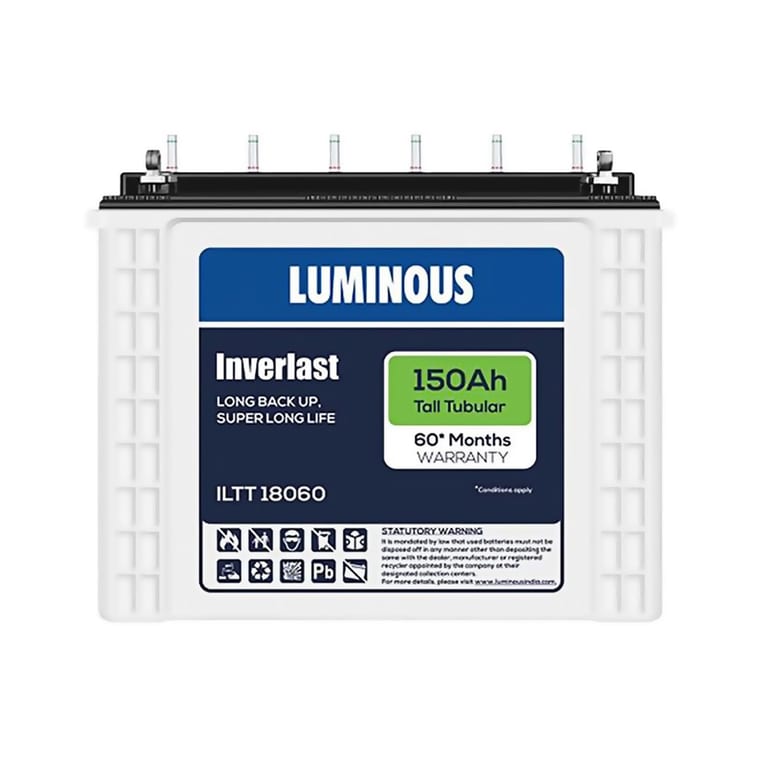
Luminous Inverlast ILTT 18060 (150Ah)
150Ah tall tubular with 36 months of free replacement plus 24 months pro-rata.
~₹14,099Amazon.in
Check price →Around ₹14,099, rated 4.3 by 216 buyers.
The ILTT 18060 is a 150Ah tall tubular battery, the size our inverter guide suggests for a typical 2BHK. It weighs about 53kg. By our formula, it runs 300W for about 4 hours and 500W for about 2 hours 27 minutes.
Its warranty is the reason to pick it over the cheaper Red Charge: 36 months of free replacement plus 24 months pro-rata, against 18 + 18. Luminous says the Inverlast range has six indicator vent plugs and a high acid reservoir that reduces top-ups, and advises a water check every 2 to 3 months.
- Buy it if you have daily power cuts and want a 150Ah battery with three years of free replacement.
- Worth knowing: it stands 44cm tall, so measure the space first. Amazon lists it as compatible with all inverter types, but Luminous publishes no VA range.
Best value inverter battery: Okaya PROPower OPSJT19060 (160Ah)
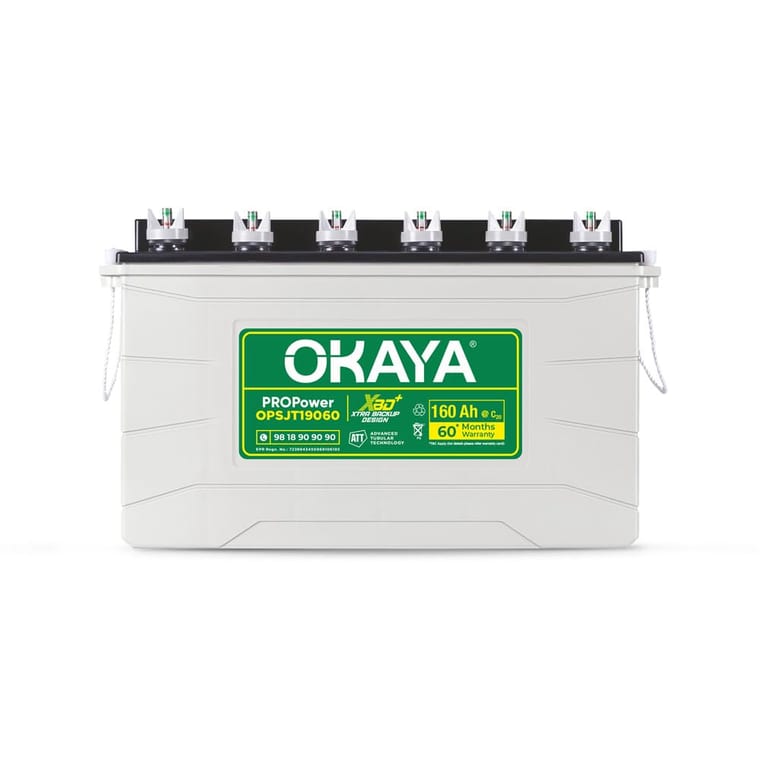
Okaya PROPower OPSJT19060 (160Ah)
160Ah and 36 months of free replacement for about ₹1,600 less than the Luminous.
~₹12,490Amazon.in
Check price →Around ₹12,490, rated 4.2 by 93 buyers.
The PROPower offers 160Ah and the same 36 months of free replacement plus 24 months pro-rata as the Luminous Inverlast, for about ₹1,600 less. At about ₹347 per month of free cover, it is the best warranty value here.
It is a super jumbo tubular battery: 54cm long, 21cm wide and 31.7cm tall, weighing about 50kg. All six water inlets are on one side, with ceramic level indicators, and Okaya says it needs topping up only once or twice a year.
Okaya's certified backup is 4 hours 40 minutes at 300W and 3 hours 5 minutes at 400W. Okaya gives no inverter VA range, but says the battery works with all Okaya UPS models.
- Buy it if you want the most capacity and free-replacement cover for the money.
- Worth knowing: the Amazon title says tall tubular, but its spec list and model code say super jumbo tubular. It also has the fewest ratings of our picks.
Best budget inverter battery: Okaya PowerON OPSJT17048 (140Ah)
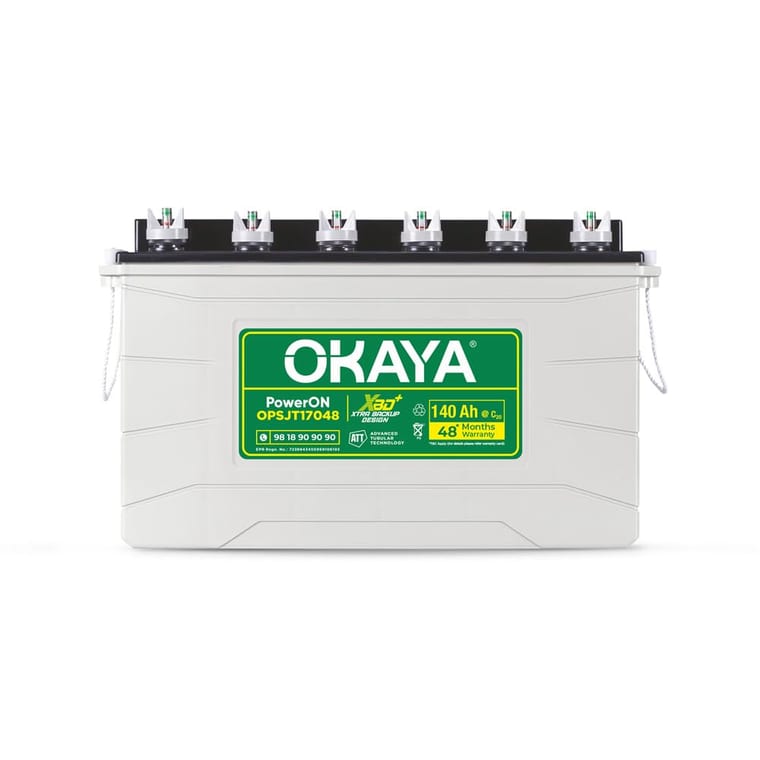
Okaya PowerON OPSJT17048 (140Ah)
140Ah super jumbo tubular, rated 4.3 by 482 buyers, with 24 months free.
~₹10,250Amazon.in
Check price →Around ₹10,250, rated 4.3 by 482 buyers, the most ratings of any pick here.
The PowerON is a 140Ah super jumbo tubular battery in the same 31.7cm-tall body as the PROPower, weighing 46.5kg. By our formula it lasts about 3 hours 48 minutes at 300W, close to Okaya's certified 3 hours 50 minutes.
The warranty is 48 months: 24 months of free replacement and 24 months pro-rata, a year less free cover than our top two picks. It has six ceramic water level indicators, and Okaya says it needs water once or twice a year. Okaya publishes no inverter VA range for it.
- Buy it if you mainly run fans and lights and want a well-rated tubular battery for about ₹10,000.
- Skip it if you want three years of free replacement. The PROPower gives that for about ₹2,240 more.
Best battery for long power cuts: Tata Green Switch-On INTT240072 (200Ah)
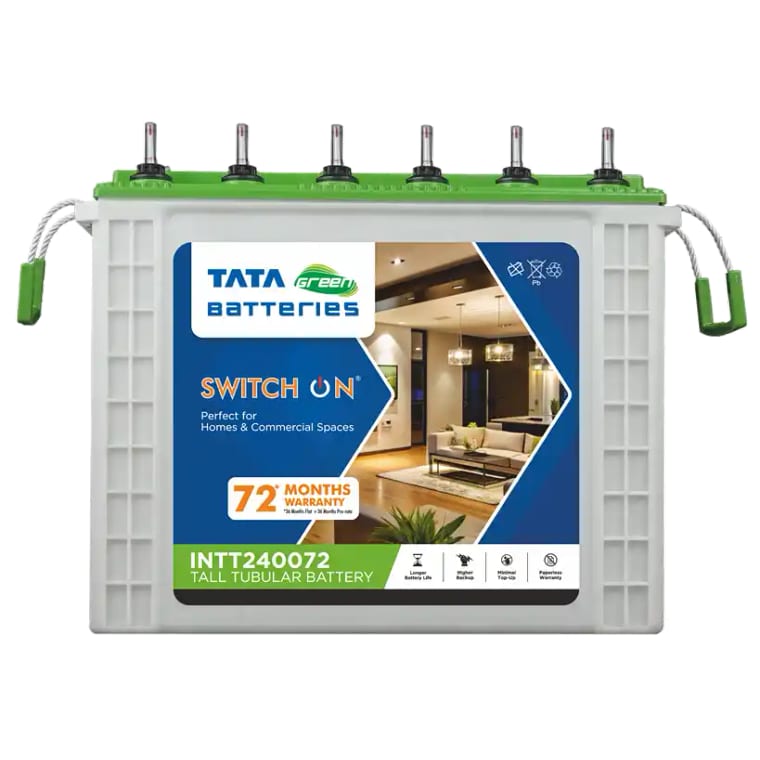
Tata Green Switch-On INTT240072 (200Ah)
200Ah for long cuts, with the longest warranty: 36 months free plus 36 pro-rata.
~₹17,348Amazon.in
Check price →Around ₹17,348, rated 4.3 by 160 buyers.
This 200Ah tall tubular battery stores a third more than a 150Ah one. By our formula, it runs 300W for about 5 hours 26 minutes and 500W for about 3 hours 16 minutes. It has six water level indicators, and Tata advises checking the electrolyte every 3 months.
It also has the longest warranty here, 72 months: 36 months of free replacement and 36 months pro-rata. Tata Green Batteries shows the same warranty on its website. The Luminous RC 25000 costs about ₹349 less but gives only 18 months free.
Amazon lists it as compatible with all inverter brands and puts its weight above 60kg. Tata's own pages give no inverter VA range.
- Buy it if your cuts often last more than four hours, or you run a fridge or cooler through them.
- Worth knowing: the 150Ah Tata Green INTT180072 costs about ₹13,444 with the same 36 + 36 month warranty, and is rated 4.0 by 149 buyers.
Best Exide inverter battery: Exide InvaMaster IMTT1500 (150Ah)
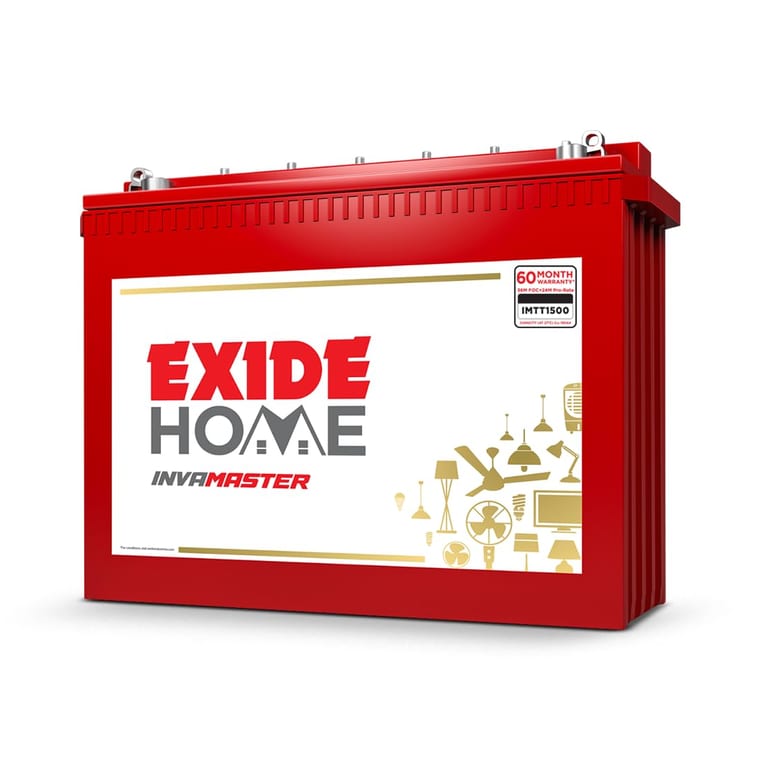
Exide InvaMaster IMTT1500 (150Ah)
Exide's 150Ah tall tubular with 36 months free, listed for 650 to 1500VA inverters.
~₹14,398Amazon.in
Check price →Around ₹14,398, rated 4.2 by 174 buyers.
The IMTT1500 is Exide's 150Ah tall tubular battery. Its warranty matches the Luminous Inverlast, 36 months of full replacement plus 24 months pro-rata, for about ₹300 more.
It is the only pick whose listing gives an inverter size range: 12V models from 650VA to 1500VA. Float indicators show the water level, and Exide suggests checking it once a month. Exide lists its filled weight at 56.8kg and rates the InvaMaster range at up to 1,000 cycles at 80% depth of discharge.
- Buy it if you prefer Exide, or an Exide dealer is closer to you than a Luminous one.
- Worth knowing: by our formula it gives the same backup as the Luminous, about 4 hours at 300W.
Best lithium inverter battery: Microtek MLB1280060 (100Ah)
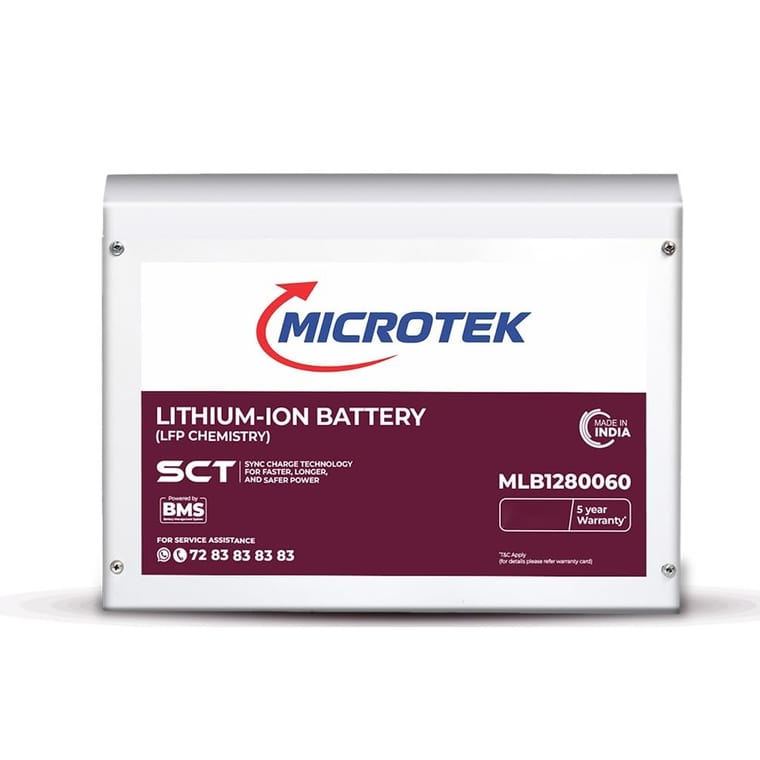
Microtek MLB1280060 Lithium (100Ah)
1280Wh LiFePO4 battery for Microtek Next-Gen inverters, about 12kg, never needs water.
~₹18,499Amazon.in
Check price →Around ₹18,499, rated 4.3 by 202 buyers.
This is a lithium iron phosphate (LiFePO4) battery rated at 12.8V and 100Ah, or 1280Wh. It needs no water, and Microtek lists it at about 12kg, under a quarter of the Luminous's 53kg. A battery management system guards against overcharging and deep discharge.
The warranty is 5 years, but neither the listing nor Microtek's website says how much is free replacement. Microtek rates it for over 4,000 cycles at 80% depth of discharge. It stores less than a 150Ah lead-acid battery, though: about 2 hours 54 minutes at 300W by our formula, against about 4 hours.
- Buy it if you own a Microtek Next-Gen inverter and want a light battery that never needs water.
- Skip it if your inverter is another brand. The listing says it supports Microtek's Next-Gen inverters, so check with your inverter's maker first.
Is a lithium inverter battery worth it?
Only if weight, space or water top-ups are a problem for you, and your inverter supports lithium. Our lithium pick costs about ₹4,400 more than the Luminous Inverlast yet stores less energy. In return, it weighs a quarter as much and is rated for a far longer life.
Spread over their rated cycles, the lithium battery works out to about ₹4.50 for each unit (kWh) it delivers, against about ₹10 for the Exide InvaMaster. Both figures are based on the makers' own ratings, and both warranties end at 5 years.
Which inverter battery brand is best in India?
Luminous, Exide and Tata Green sell 150Ah tubular batteries, and Okaya a 160Ah one, with 36 months of free replacement. Of the batteries we saw on Amazon.in, Luminous's Red Charge models had the most ratings, 1,050 to 1,614. Choose by the months of free replacement, the price and the nearest service centre.
Microtek's lithium battery was the top seller among inverter batteries on Amazon.in when we checked. Amaron's tall tubular batteries had no buy button there, though its 200Ah AR200TT54 lists 36 months free plus 18 pro-rata. V-Guard and Livfast battery listings had too few ratings to judge.
How do you look after an inverter battery?
On a lead-acid battery, check the water level indicators often and top up with distilled water only. Exide suggests a check once a month for tubular batteries, and Luminous every 2 to 3 months. Microtek suggests every 30 to 45 days in summer, when heat makes the water evaporate faster.
- Fill only to the marked level, as Microtek advises.
- Place the battery in an airy spot that children cannot reach, because lead-acid batteries give off gas while charging.
- Clean white deposits off the terminals and apply a little petroleum jelly, as Microtek suggests.
- Most room coolers draw 100 to 200W, so a cooler from our air cooler guide runs for 6 hours or more on a charged 150Ah battery.
- Leave heaters off the inverter. A 2,000W room heater would empty a 150Ah battery in under 40 minutes, and most home inverters cannot supply that much power.
Charging phones from a power bank during long cuts also leaves more battery for fans and lights.
What to check before you buy
- Capacity (Ah). 150Ah suits most homes. Choose 200Ah for cuts of four hours or more, or loads above 500W.
- Battery type. Tall tubular for long, frequent cuts, super jumbo tubular if height is tight, and lithium only if your inverter supports it.
- Warranty split. Count the free-replacement months. 36 is good, and 18 is weak.
- Price per month of cover. Divide the price by the free-replacement months to compare fairly.
- Your inverter. Check its manual for the battery voltage and the Ah range it supports.
- Water top-ups and indicators. A float indicator on each cell makes checks quick.
- Weight and delivery. Our lead-acid picks weigh 46kg or more. Ask whether installation and pickup of the old battery are included.
- Registration. Exide's warranty runs from the date of purchase or registration, so register the battery and keep the invoice.
Which inverter battery should you buy?
For most homes, buy the Luminous Inverlast ILTT 18060 at around ₹14,099. It is a 150Ah tall tubular battery with 36 months of free replacement, and it runs 300W of fans and lights for about 4 hours.
To spend less, the Okaya PROPower OPSJT19060 at around ₹12,490 gives 160Ah and the same free cover. For long daily cuts, the 200Ah Tata Green INTT240072 at around ₹17,348 adds over an hour of backup at 300W and has the longest warranty.
Still choosing the inverter? Our inverter guide compares models from 900VA to 1400VA.